
NILU and three other Norwegian research institutes propose establishing a national data ecosystem that would provide integrated access to Norway’s environmental and marine data.
The aim of the proposal is to make valuable Norwegian environmental and marine data more accessible for research, public administration and artificial intelligence (AI).
Today, vast amounts of data on our oceans, climate and environment are scattered across different research institutes, and often, data is stored in different formats and resolution. Although much of this data is intended to be openly available, it can be difficult to find – and even harder to understand, combine and reuse across sectors and scientific disciplines.
Recognising the importance of making better use of existing data, the Norwegian Ministry of Climate and Environment and the Ministry of Trade, Industry and Fisheries commissioned a feasibility study on establishing a shared ecosystem for environmental and marine data.
Since June, the Norwegian Meteorological Institute, NILU, the Institute of Marine Research and NORCE have been working on the proposal on behalf of the two ministries. The project outline has now been submitted.
“A shared data space is important because it makes it possible to find, combine and use environmental and marine data across institutions. This can reveal new connections and provide valuable insights, leading to better decisions and greater benefits for society,” says Cathrine Lund Myhre, Senior Scientist and Head of NILU’s Centre for Atmospheric Data.
“Another important goal is to make the data ready for use in AI applications, opening up new opportunities for how the data can be used.”
Data owners retain control
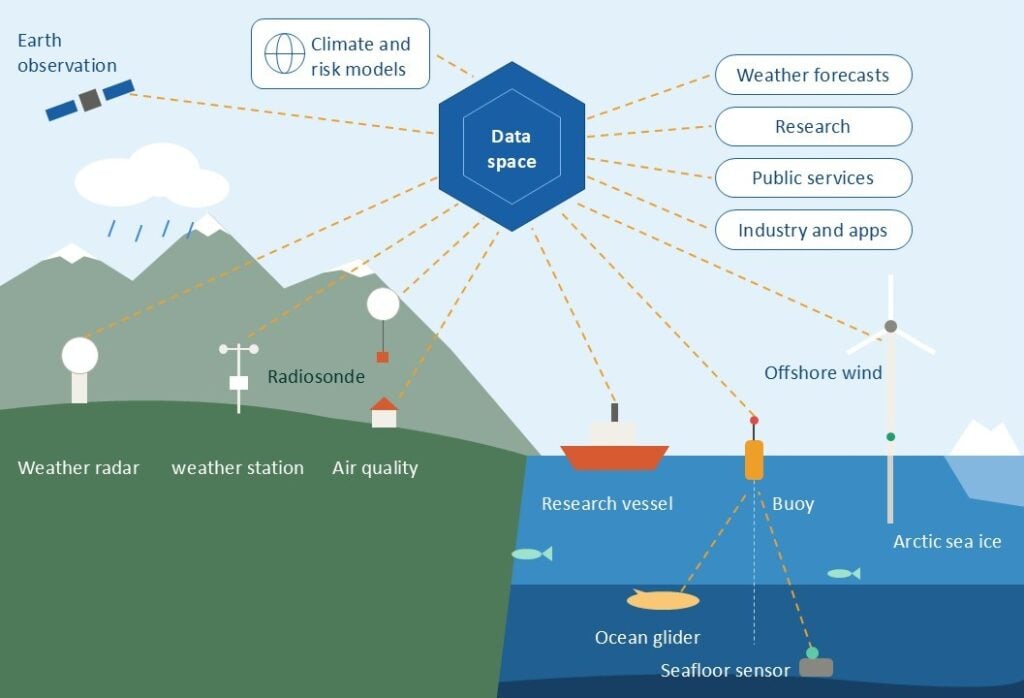
Bringing all Norwegian environmental data together in one large, centralised database would involve significant risks and costs. Instead, the research institutes propose establishing an interconnected data space.
Under this approach, data would remain with their original owners but be connected through common rules, open international standards, open application programming interfaces (APIs) and a shared metadata catalogue.
This would allow data owners to retain control over their data while enabling users to search for, access and combine information through automated processes.
“The data stays with its owners, but becomes far more valuable when it can be connected and used together rather than remaining in separate silos,” says Lund Myhre.
Benefits for research, public administration and businesses
The proposed data ecosystem would offer a wide range of benefits for researchers, national and local authorities, and the private sector.
“In practical terms, the ecosystem would enable faster responses and better insights during floods, wildfires and acute pollution incidents. It would also simplify reporting under international agreements and EU requirements,” says Stefan Jetschny, Senior Scientist at NILU.
He also highlights the importance of providing data with documented quality, origin and licensing conditions. This would create a reliable foundation for businesses developing new services, as well as for AI agents accessing data through machine-readable interfaces.
“Publicly funded data would be put to better use, duplication of effort would be reduced, and Norway would gain a more secure connection to European initiatives such as the Green Deal Data Space. At the same time, data owners would retain control over licensing and access,” he explains.
Reaching agreement will be essential
Establishing a shared data ecosystem will require time, effort and funding, both during development and for long-term operation.
Data providers will need to invest resources in documenting and preparing their data according to common minimum requirements. Increased demand for data could also create additional work at the institutional level. Furthermore, shared governance will require agreement among many stakeholders, potentially slowing down decision-making.
“These challenges are real, but they largely involve one-off costs and practical issues that can be managed. The benefits, on the other hand, are long-lasting and will grow as more organisations participate. The advantages and opportunities therefore clearly outweigh the disadvantages,” Jetschny emphasises.
As a first step, the research institutes propose a four-year implementation project, with the first year dedicated to piloting and testing the solution in practice.
The estimated cost of the initial pilot phase is NOK 18.5 million.
To ensure the ecosystem remains viable in the long term, stable and predictable national core funding will be essential.