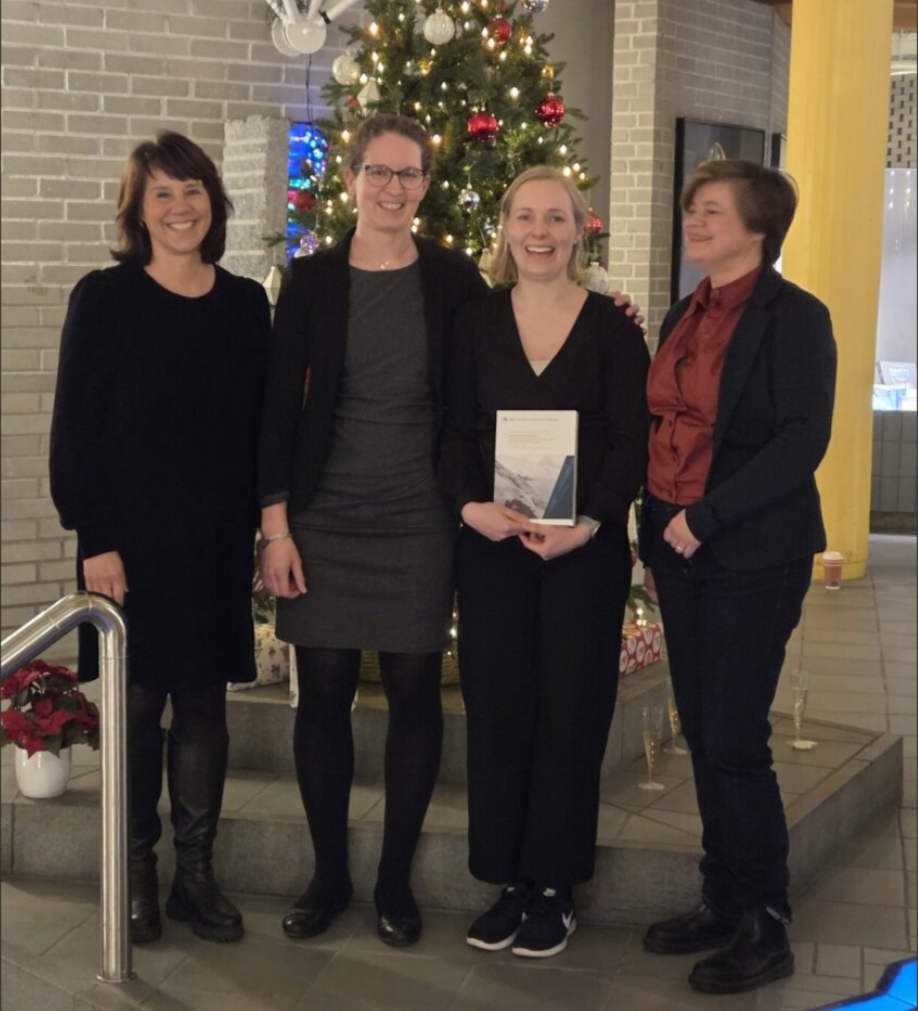
December 16 2025: Lovise Pedersen Skogeng of the Department of Arctic and Marine Biology at UiT – the Arctic University of Norway and NILU’s Department of Environmental Chemistry and Health Effects has successfully defended her PhD thesis “From Sources to Seabirds – Tracking Organic Pollutants from European Air to Arctic Seabirds over time and space“.
Even though harmful chemicals known as persistent organic pollutants (POPs) are banned, they’re still turning up in remote Arctic areas – and so are their modern replacements.
Tracking POPs through the air
In their study, Skogeng et.al. found both old and new pollutants in European air. They also found old POPs in the Arctic seabird common eider, thus showing that these chemicals can travel long distances and bioaccumulate.
Some of the banned POPs were found in increasing levels in both air and common eiders over the past decade. Warmer temperatures were linked to higher concentrations of POPs in eiders, suggesting that climate change is making the problem worse.
Skogeng and her colleagues further developed a model for predicting contaminant exposure in Arctic seabirds, predicting declining concentrations following decreasing global emissions of POPs.
Her thesis highlights that continued monitoring and action are needed to protect Arctic wildlife from both old and new chemical threats, especially under the changing climate.
Lovise’s supervisors were Associate Professor II Dorte Herzke, Department of Arctic and Marine Biology (UiT), NIPH & NILU, Senior Scientist Dr Ingjerd Sunde Krogseth, NILU & Department of Arctic and Marine Biology (UiT), Senior Scientist Dr Knut Breivik, NILU & UiO and Research Manager Dr Anita Evenset, Akvaplan Niva.
Watch a recording of Lovise’s public defense here: https://uit.no/tavla/artikkel/915656/trial_lecture_and_disputation_-_msc_in_chemistry
Our congratulations!