A new global analysis maps how economic growth in thousands of cities is evolving in relation to fossil fuel use. Satellites have been used to measure both growth and pollution.
Amirhossein Hassani, Daniel Dean Moran, Sam-Erik Walker, Kerstin Stebel, and Philipp Schneider
A new study, published this week in Nature Cities, provides one of the first globally consistent assessments of whether cities are managing to grow economically while reducing dependence on fossil fuel combustion.
Satellite data indicate fossil fuel use
Cities are responsible for a large share of both global economic activity and emissions, making them central to climate and sustainability transitions. However, tracking whether cities are successfully “decoupling” economic growth from fossil fuel use has long been difficult due to inconsistent and incomplete data on both emissions and urban economies.
To overcome this, a new global study led by scientists from NILU and international partners, for the first time tracks how economic growth in thousands of cities is evolving in relation to fossil fuel use. Satellite measurements of nitrogen dioxide (NO₂) from the European Sentinel-5P TROPOMI instrument were used as an indicator of combustion-related activity, combined with subnational economic data (GDP per capita adjusted for purchasing power). NO₂ is closely linked to emissions from transport, industry, and power generation, and provides a globally consistent way to track changes in fossil fuel use at the city scale.
“It is encouraging to see green growth in action, especially since we know that cities have the same power, and often much more willingness than national politicians, to go fossil-free,” said Daniel Moran, co-author of the study.

Clear regional differences
The worldwide analysis covers 5,435 cities with populations above 100,000 over the period 2019–2024. Of these, 2,475 cities showed statistically significant trends in NO₂ levels and were classified according to how pollution and economic growth evolved together.
The results show that around 80% of these cities experienced relative decoupling, meaning that economic growth increased while NO₂ pollution decreased or grew more slowly. These cities are mainly located in China, Europe, and North America. In contrast, about 16% of cities, primarily in India, the Middle East, and parts of Central Asia, showed fossil fuel-dependent growth, where both economic activity and NO₂ levels increased.
“The progress in some regions, especially in China, is remarkable”, said Amir Hassani, lead author of the study. “Some regions have discovered how to grow without using more fossil fuels.”
Clear regional differences emerge from the analysis. Many cities in East Asia and Europe show strong signs of decoupling, likely reflecting air quality policies, energy transitions, and changes in industrial structure. For example, several major Chinese cities, including Beijing and Shanghai, show declining NO₂ levels alongside continued economic growth, consistent with large-scale air quality management and electrification efforts. Similar patterns are observed in European cities such as Paris, Berlin, and Amsterdam.
The study does not consider outsourcing, notes Moran. “It is possible that wealthy cities can reduce emissions locally while their global footprint continues to grow.” The authors say this trend is unlikely to affect the results during the relatively short 6-year window considered in the study.
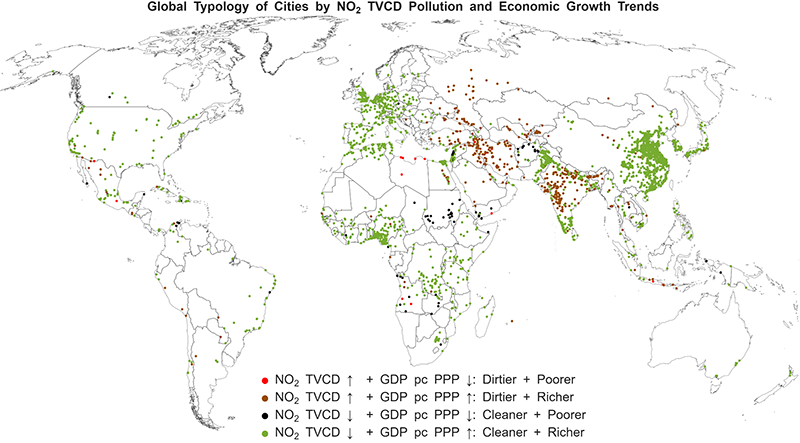
However, rapidly growing urban areas in parts of South Asia and the Middle East continue to show increasing dependence on fossil fuels. This suggests that economic expansion in these regions remains closely tied to combustion-based energy systems.
A new tool for monitoring urban sustainability
The study emphasizes that NO₂ is not a measure of carbon dioxide emissions or overall environmental impact, but rather an indicator of combustion-related activity. The approach therefore captures ‘relative decoupling’, changes in the relationship between economic growth and fossil fuel use, rather than absolute emissions reductions.
The research also highlights important uncertainties, including differences in economic data quality across countries and the relatively short analysis period of six years, which includes the COVID-19 pandemic.
Beyond these limitations, it introduces a scalable framework that can be regularly updated using satellite data, as a new tool for monitoring urban sustainability transitions and supporting climate and energy policy. Continued progress will likely depend on targeted policies, technological change, and international cooperation, particularly in rapidly urbanizing regions where fossil fuel dependence remains high.